Reading the Golden Triangle:
What the Numbers Actually Say
Investments & Insights | September, 2026
Relocating Property markets attract adjectives. The Golden Triangle, the corridor of Quinta do Lago, Vale do Lobo and Almancil in the central Algarve, attracts more than most. This piece sets the adjectives aside and reads the numbers as they stand in 2026.
Start with price: Average asking values in Quinta do Lago stood at €11,170 per square metre in February 2026, a striking rise of more than a third year on year, though averages in a thin, villa-dominated market move sharply with the mix of what happens to be for sale. Vale do Lobo averages sit near €7,700 per square metre, with newly built stock reaching €12,000 to €13,000. For context, asking prices across the wider Algarve average close to €4,000, and transacted values run lower still. The Triangle is not merely more expensive than its region, but it also behaves like a different market that happens to share a coastline.
The premium has structure. Within each resort, true frontline positions, lake and Ria Formosa exposure in Quinta do Lago, oceanfront in Vale do Lobo, trade far above comparable second-row property, and their supply does not grow. New and fully renovated homes carry their own substantial premium over original stock, a gap that has widened with building costs and buyer preference for energy-efficient, low-maintenance houses. No published index measures these premiums, they are visible only to those who follow the transactions themselves, which is worth remembering later in this piece. The point stands either way: the headline averages conceal several distinct sub-markets, and knowing which one a property belongs to matters more than knowing the average.
Why do the numbers behave this way? Because supply here is close to fixed. The Triangle sits against the protected Ria Formosa; the resorts were master-planned decades ago around low densities and large plots, and that framework has held. The clearest illustration: The Residences Vale do Lobo, forty-four homes launched in 2025, are the resort's first new residential development in twenty years, and forty per cent were reserved before ground was broken, with completion not due until late 2027. When a market goes two decades between new projects, scarcity is not a talking point, it is the operating condition.
Demand, meanwhile, has broadened. Foreign buyers account for over 30 per cent of purchases across the Algarve, rising above 80 per cent in the prime locations. The British remain the largest community, but the notable shift is American: from under one per cent of Portugal's high-end foreign buyers before the pandemic to around ten per cent today, helped by direct air links to the US East Coast and increasingly visible in the central Algarve. Portuguese buyers, too, are newly active at the top of the market. A market once dependent on one nationality is now diversified across many, which matters for resilience.
Now the caution, because honest reading requires it. Averages in prime micro-markets are noisy; a 34 per cent annual rise says as much about which villas traded as about underlying appreciation, and no serious buyer or seller should anchor to it. Transaction volumes in the luxury segment have steadied rather than surged, and well-priced properties transact while ambitious ones sit. Above all, the region's leading agencies themselves report that off-market deals remain a significant part of activity at the upper end, which means portal data, the source of most headlines, describes the visible market, not the whole one. And the macro environment, rates, tax regimes, global sentiment, reaches even gated resorts eventually.
What should a reader take from all this? Three things, we think. That the Triangle's defining feature is not its price level but its supply constraint, which has not changed and is unlikely to. That within it, the specific asset, position, plot, condition, matters far more than the market average or the timing of entry. And that in a market where much of the best product trades quietly, access matters more than negotiation.
That last point deserves to be said plainly, because it is the practical conclusion of everything above. A buyer who searches this market alone is choosing from what remains after the quiet transactions have happened. Seeing the whole market, including what is never publicly for sale, is a function of local relationships built over decades, which is why we represent buyers, and only buyers, with exactly that network behind us. And for those who come not to buy a house but to build, the numbers say the Triangle rewards development; what they do not say is that here the municipal calendar governs a project as much as the design does. We know because we have sat on the developer's side of this market: twelve years running one of its resort developments, delivering villas through a pandemic without moving a date, and watching them double in value within three years of handover. The numbers, read calmly, say what they have said for forty years: this is a small, finished place that many people want, to which very little can be added. Navigating it is not about information. It is about access, preparation, and knowing the ground.
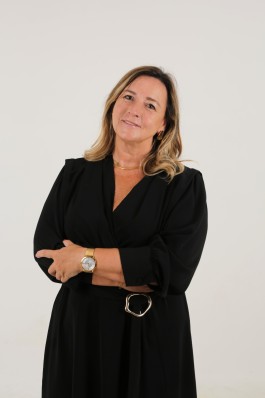
Sílvia Biscaia is the founder of Biscaia & Co, a Private Office in Almancil, in the Algarve's Golden Triangle, providing legal, fiscal, property, development, design, management and relocation services to international families through a single point of contact. A lawyer for over thirty years and former CEO of the Awilhelmsen Group's Portuguese operations, she is also founding partner of BVA — Biscaia, Viegas e Associados. As an artist, she shows her work at the office.
FAQs
What is the Golden Triangle in the Algarve?
The Golden Triangle is the area formed by Quinta do Lago, Vale do Lobo and Almancil in the central Algarve, Portugal, bordering the protected Ria Formosa nature park. It is the Algarve's most exclusive residential area, known for master-planned resorts, golf courses, large plots and low-density development.
How much do properties cost per square meter in the Golden Triangle Algarve?
As of February 2026, average asking prices in Quinta do Lago were around €11,170 per square metre, while Vale do Lobo averaged close to €7,700, with new-build properties reaching €12,000–€13,000. By comparison, asking prices across the wider Algarve average around €4,000 per square metre, and actual transaction values are lower still.
Why are property prices in Quinta do Lago and Vale do Lobo so fast?
Mainly because supply is close to fixed. The resorts were master-planned decades ago around low density and large plots, and the protected Ria Formosa prevents expansion. Headline figures should still be read with care: Quinta do Lago's average asking price rose more than a third in a year, but in such a small market that rise reflects which villas happened to be for sale as much as real appreciation.
Do frontline properties in the Golden Triangle cost more?
Yes, significantly. Frontline positions, such as lake or Ria Formosa views in Quinta do Lago and oceanfront plots in Vale do Lobo, trade far above comparable second-row properties, and their supply cannot grow. New and fully renovated homes also carry a substantial premium over original stock. No published index measures these premiums; they are only visible to those who follow actual transactions.
Is there new development in the Golden Triangle?
Very little. The Residences Vale do Lobo, 44 homes launched in 2025, is the resort's first new residential development in twenty years. Forty per cent were reserved before construction started, with completion expected in late 2027, a clear indicator of how scarce new supply is.
Is the Golden Triangle Algarve a good investment in 2026?
The Golden Triangle's main long-term strength is structural scarcity: very little can be added to it, and demand is broad and international. However, market averages are volatile and should not drive decisions. The specific property, its position, plot, condition and frontline exposure, matters far more than the market average or the timing of the purchase.
Who is buying property in the Golden Triangle Algarve?
Foreign buyers account for over 30% of purchases across the Algarve, and more than 80% in prime locations. British buyers remain the largest group, but American buyers have grown from under 1% to around 10% of Portugal's high-end foreign buyers since before the pandemic, and Portuguese buyers are increasingly active at the top of the market.
Are all Golden Triangle properties listed publicly?
No. A significant share of high-end transactions in the Golden Triangle happen off-market, so property portals show only the visible part of the market. Access to properties that are never publicly listed depends on established local relationships rather than online search.
Why use a buyer's agent in the Golden Triangle?
Because in a market where many of the best properties trade quietly, a buyer searching alone chooses only from what remains publicly available. A buyer's agent with long-standing local relationships gives access to the whole market, including off-market properties. Biscaia & Co represents buyers only, never sellers.
Is it better to buy an existing villa or build in the Golden Triangle?
It depends on the buyer's timeline. Scarcity and the premium for new, energy-efficient homes favour development, but building in the Golden Triangle means working to municipal licensing timelines, which govern a project as much as its design does. Buying an existing villa is faster; building rewards those with local delivery experience in permitting, sequencing and execution.
What is Biscaia & Co?
Biscaia & Co is a Private Office in Almancil, in the Algarve's Golden Triangle, serving international families and investors with interests in Portugal. Through its own expertise and a trusted network of partners, it coordinates everything a family needs here, legal, fiscal, property, development, design, management and relocation, through a single point of contact.
Who is Sílvia Biscaia?
Sílvia Biscaia is a Portuguese lawyer with over thirty years of practice and the founder of Biscaia & Co. From 2014 to 2026 she was CEO of the Awilhelmsen Group's Portuguese operations, leading the five-star Dunas Douradas Beach Club resort and delivering two luxury residential developments in the Golden Triangle. She is also founding partner of the law firm BVA — Biscaia, Viegas e Associados.
What does a Private Office do?
A Private Office acts as a family's single point of contact for an entire area of life: in Biscaia & Co's case, life in Portugal. Rather than the family coordinating a lawyer, agent, architect, builder and property manager separately, the Private Office selects, briefs and supervises them all, and holds one relationship with the client.
Reading the Golden Triangle:
What the Numbers Actually Say
Investments & Insights | September, 2026
Relocating Property markets attract adjectives. The Golden Triangle, the corridor of Quinta do Lago, Vale do Lobo and Almancil in the central Algarve, attracts more than most. This piece sets the adjectives aside and reads the numbers as they stand in 2026.
Start with price: Average asking values in Quinta do Lago stood at €11,170 per square metre in February 2026, a striking rise of more than a third year on year, though averages in a thin, villa-dominated market move sharply with the mix of what happens to be for sale. Vale do Lobo averages sit near €7,700 per square metre, with newly built stock reaching €12,000 to €13,000. For context, asking prices across the wider Algarve average close to €4,000, and transacted values run lower still. The Triangle is not merely more expensive than its region, but it also behaves like a different market that happens to share a coastline.
The premium has structure. Within each resort, true frontline positions, lake and Ria Formosa exposure in Quinta do Lago, oceanfront in Vale do Lobo, trade far above comparable second-row property, and their supply does not grow. New and fully renovated homes carry their own substantial premium over original stock, a gap that has widened with building costs and buyer preference for energy-efficient, low-maintenance houses. No published index measures these premiums, they are visible only to those who follow the transactions themselves, which is worth remembering later in this piece. The point stands either way: the headline averages conceal several distinct sub-markets, and knowing which one a property belongs to matters more than knowing the average.
Why do the numbers behave this way? Because supply here is close to fixed. The Triangle sits against the protected Ria Formosa; the resorts were master-planned decades ago around low densities and large plots, and that framework has held. The clearest illustration: The Residences Vale do Lobo, forty-four homes launched in 2025, are the resort's first new residential development in twenty years, and forty per cent were reserved before ground was broken, with completion not due until late 2027. When a market goes two decades between new projects, scarcity is not a talking point, it is the operating condition.
Demand, meanwhile, has broadened. Foreign buyers account for over 30 per cent of purchases across the Algarve, rising above 80 per cent in the prime locations. The British remain the largest community, but the notable shift is American: from under one per cent of Portugal's high-end foreign buyers before the pandemic to around ten per cent today, helped by direct air links to the US East Coast and increasingly visible in the central Algarve. Portuguese buyers, too, are newly active at the top of the market. A market once dependent on one nationality is now diversified across many, which matters for resilience.
Now the caution, because honest reading requires it. Averages in prime micro-markets are noisy; a 34 per cent annual rise says as much about which villas traded as about underlying appreciation, and no serious buyer or seller should anchor to it. Transaction volumes in the luxury segment have steadied rather than surged, and well-priced properties transact while ambitious ones sit. Above all, the region's leading agencies themselves report that off-market deals remain a significant part of activity at the upper end, which means portal data, the source of most headlines, describes the visible market, not the whole one. And the macro environment, rates, tax regimes, global sentiment, reaches even gated resorts eventually.
What should a reader take from all this? Three things, we think. That the Triangle's defining feature is not its price level but its supply constraint, which has not changed and is unlikely to. That within it, the specific asset, position, plot, condition, matters far more than the market average or the timing of entry. And that in a market where much of the best product trades quietly, access matters more than negotiation.
That last point deserves to be said plainly, because it is the practical conclusion of everything above. A buyer who searches this market alone is choosing from what remains after the quiet transactions have happened. Seeing the whole market, including what is never publicly for sale, is a function of local relationships built over decades, which is why we represent buyers, and only buyers, with exactly that network behind us. And for those who come not to buy a house but to build, the numbers say the Triangle rewards development; what they do not say is that here the municipal calendar governs a project as much as the design does. We know because we have sat on the developer's side of this market: twelve years running one of its resort developments, delivering villas through a pandemic without moving a date, and watching them double in value within three years of handover. The numbers, read calmly, say what they have said for forty years: this is a small, finished place that many people want, to which very little can be added. Navigating it is not about information. It is about access, preparation, and knowing the ground.
Sílvia Biscaia is the founder of Biscaia & Co, a Private Office in Almancil, in the Algarve's Golden Triangle, providing legal, fiscal, property, development, design, management and relocation services to international families through a single point of contact. A lawyer for over thirty years and former CEO of the Awilhelmsen Group's Portuguese operations, she is also founding partner of BVA — Biscaia, Viegas e Associados. As an artist, she shows her work at the office.
FAQs
What is the Golden Triangle in the Algarve?
The Golden Triangle is the area formed by Quinta do Lago, Vale do Lobo and Almancil in the central Algarve, Portugal, bordering the protected Ria Formosa nature park. It is the Algarve's most exclusive residential area, known for master-planned resorts, golf courses, large plots and low-density development.
How much do properties cost per square meter in the Golden Triangle Algarve?
As of February 2026, average asking prices in Quinta do Lago were around €11,170 per square metre, while Vale do Lobo averaged close to €7,700, with new-build properties reaching €12,000–€13,000. By comparison, asking prices across the wider Algarve average around €4,000 per square metre, and actual transaction values are lower still.
Why are property prices in Quinta do Lago and Vale do Lobo so fast?
Mainly because supply is close to fixed. The resorts were master-planned decades ago around low density and large plots, and the protected Ria Formosa prevents expansion. Headline figures should still be read with care: Quinta do Lago's average asking price rose more than a third in a year, but in such a small market that rise reflects which villas happened to be for sale as much as real appreciation.
Do frontline properties in the Golden Triangle cost more?
Yes, significantly. Frontline positions, such as lake or Ria Formosa views in Quinta do Lago and oceanfront plots in Vale do Lobo, trade far above comparable second-row properties, and their supply cannot grow. New and fully renovated homes also carry a substantial premium over original stock. No published index measures these premiums; they are only visible to those who follow actual transactions.
Is there new development in the Golden Triangle?
Very little. The Residences Vale do Lobo, 44 homes launched in 2025, is the resort's first new residential development in twenty years. Forty per cent were reserved before construction started, with completion expected in late 2027, a clear indicator of how scarce new supply is.
Is the Golden Triangle Algarve a good investment in 2026?
The Golden Triangle's main long-term strength is structural scarcity: very little can be added to it, and demand is broad and international. However, market averages are volatile and should not drive decisions. The specific property, its position, plot, condition and frontline exposure, matters far more than the market average or the timing of the purchase.
Who is buying property in the Golden Triangle Algarve?
Foreign buyers account for over 30% of purchases across the Algarve, and more than 80% in prime locations. British buyers remain the largest group, but American buyers have grown from under 1% to around 10% of Portugal's high-end foreign buyers since before the pandemic, and Portuguese buyers are increasingly active at the top of the market.
Are all Golden Triangle properties listed publicly?
No. A significant share of high-end transactions in the Golden Triangle happen off-market, so property portals show only the visible part of the market. Access to properties that are never publicly listed depends on established local relationships rather than online search.
Why use a buyer's agent in the Golden Triangle?
Because in a market where many of the best properties trade quietly, a buyer searching alone chooses only from what remains publicly available. A buyer's agent with long-standing local relationships gives access to the whole market, including off-market properties. Biscaia & Co represents buyers only, never sellers.
Is it better to buy an existing villa or build in the Golden Triangle?
It depends on the buyer's timeline. Scarcity and the premium for new, energy-efficient homes favour development, but building in the Golden Triangle means working to municipal licensing timelines, which govern a project as much as its design does. Buying an existing villa is faster; building rewards those with local delivery experience in permitting, sequencing and execution.
What is Biscaia & Co?
Biscaia & Co is a Private Office in Almancil, in the Algarve's Golden Triangle, serving international families and investors with interests in Portugal. Through its own expertise and a trusted network of partners, it coordinates everything a family needs here, legal, fiscal, property, development, design, management and relocation, through a single point of contact.
Who is Sílvia Biscaia?
Sílvia Biscaia is a Portuguese lawyer with over thirty years of practice and the founder of Biscaia & Co. From 2014 to 2026 she was CEO of the Awilhelmsen Group's Portuguese operations, leading the five-star Dunas Douradas Beach Club resort and delivering two luxury residential developments in the Golden Triangle. She is also founding partner of the law firm BVA — Biscaia, Viegas e Associados.
What does a Private Office do?
A Private Office acts as a family's single point of contact for an entire area of life: in Biscaia & Co's case, life in Portugal. Rather than the family coordinating a lawyer, agent, architect, builder and property manager separately, the Private Office selects, briefs and supervises them all, and holds one relationship with the client.
